Concrete on Waco's Black Clay: Cracks, Heave and Central Texas Weather
Waco Elite Concrete pours and repairs concrete in Waco, Texas, on black clay that moves with the weather: the USDA counts Houston Black clay, one of the two largest soil map units in its McLennan County survey, among the world's classic shrink-swell soils.
Texas Parks and Wildlife traces the region's black, heavy clays to the Upper Cretaceous chalks, marls, limestones and shales under the Blackland Prairie, which reaches into eastern McLennan County. Add 100-degree summers, hard freezes and a wet spring and fall, and it pays to know what the ground and the weather do to a slab before one is poured, and what fixes one that has already cracked, heaved or sunk.
Call or request a free estimate any time, 24/7
Houston Black and the Blackland Prairie clays
In the USDA's soil survey of McLennan County (version 25, dated September 3, 2026), the two largest map units are Wilson clay loam, at 42,381 acres, and Houston Black clay, at 41,197. The county soil survey published in 2001 groups Ferris, Heiden, Houston Black, Slidell and Sanger as clayey upland soils; together they take in about 26 percent of the county, and the survey rates most of them high in shrink-swell potential. The USDA's Texas Blackland Prairie land resource area, which takes in Waco, covers about 15,110 square miles.
How much clay it holds
The USDA's official description gives Houston Black 40 to 60 percent clay, formed from calcareous mudstone, and calls it very slowly permeable. NRCS data for the county's Houston Black clay read 54 to 55 percent clay in every layer, with a plasticity index of 44 to 45 and a linear extensibility, its measure of shrink and swell, of 12 percent. Wilson clay loam has a 31 percent clay topsoil over a 42.5 percent clay subsoil.
How it cracks and swells
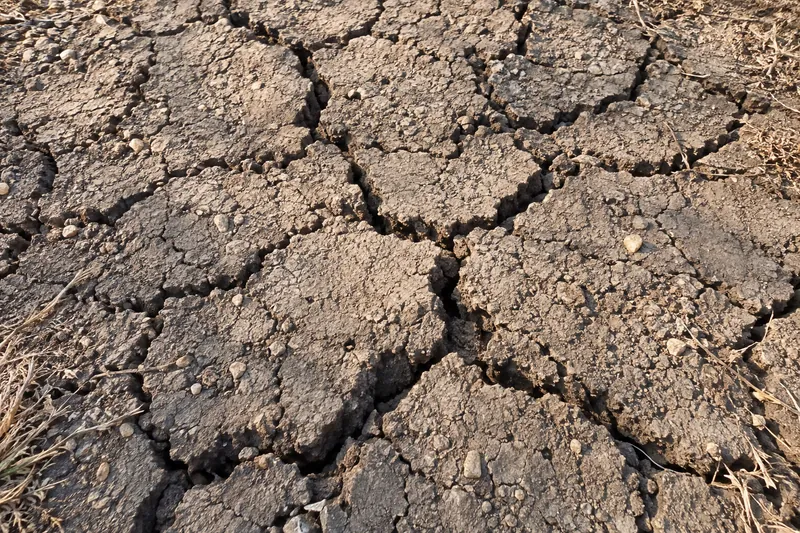
When it dries, Houston Black opens cracks ½ to 4 inches wide that run from the surface to 12 inches deep or more and stay open 90 to 150 cumulative days in most years. Water enters rapidly while the soil is dry and cracked, then very slowly once it's moist. Texas A&M AgriLife Extension's Travis County office says these black clays heave objects like fence posts and patios, which is why a new patio in Waco starts with the ground under it, and AgriLife's Blackland Research and Extension Center at Temple lists "Shrinkage, swelling, cracking and stickiness" as the soil's outstanding structural features.
Call or request a free estimate any time, 24/7.
(254) 309-9254What the soil survey says about driveways and slabs
The survey rates each soil for concrete driveways and sidewalks, which NRCS describes as poured concrete slabs 3 to 6 inches thick, rating each soil in its undisturbed condition. In McLennan County, Houston Black, Heiden, Slidell, Branyon and Crawford soils all rate "Very limited" because of high shrink-swell, and Tinn clay for flooding too.
In NRCS's own words, a "Very limited" soil's limitations "generally cannot be overcome without major soil reclamation, special design, or expensive installation procedures", and "Poor performance and high maintenance can be expected." Aledo soils carry the same rating for a different reason, hard bedrock close to the surface, and Purves clay for both shallow bedrock and high shrink-swell. Our pages on driveways and sidewalks and walkways show how the base is planned on these soils.
- Houston Black clay
- Very limited
- Heiden clay
- Very limited
- Slidell silty clay
- Very limited
- Branyon clay
- Very limited
- Crawford silty clay
- Very limited
- Wilson clay loam
- Somewhat limited
- Stephen soils
- Somewhat limited
- Eddy and Bosque soils
- Not limited
USDA NRCS, Soil Survey of McLennan County, Texas (2026 data), main soil of each map unit.
Call or request a free estimate any time, 24/7.
(254) 309-9254Building concrete for expansive clay
What follows is industry and code practice for building on clay, not a promise about any one job. Before a price is set, Waco Elite Concrete will talk through which of these points your lot calls for; typical figures for each line are in the Waco concrete cost guide.
Base, steel and joints
On expansive soils, one published guide puts 2 to 8 inches of crushed rock under a driveway as subgrade material, more as the soil gets more expansive, with soft spots dug out and replaced. The National Ready Mixed Concrete Association says mesh and rebar can't prevent cracking but can limit crack width, and keeps contraction joints within 24 to 36 times the slab's depth, roughly 10 feet apart on a 4-inch slab and never past 15 feet. Isolation joints let a driveway or patio move on its own, apart from a sidewalk, a garage slab or a set of steps. Thickness and steel for a drive are set out in the driveway thickness, rebar and curing guide.
Slab foundations
For a house, the 2024 International Residential Code that Waco enforces requires foundations and floor slabs on expansive soils to be designed under the International Building Code's Section 1808.6. The Post-Tensioning Institute's guidelines for post-tensioned foundations on expansive soils were adopted by the model building codes and "have been used on millions of residential foundations since 1980", and the Soil Science Society of America says hydrated lime is often added to stabilize Houston Black and that foundations on it need steel reinforcement. Our page on concrete slabs and slab foundations covers the slab itself.
Drainage and grading
Wet clay swells, so the water around a slab matters as much as the slab. Under the 2024 IRC, the ground has to drop at least 6 inches over the first 10 feet from a house, and hard surfaces such as paving within 10 feet of the foundation must slope at least 2 percent away. Streets on the same clays last longer, the county soil survey says, with a heavier flexible base, more depth of lime-stabilized subgrade and moisture barriers.
Planning a slab or driveway on clay? Call or request a free estimate, 24/7.
(254) 309-9254Central Texas weather and fresh concrete
The figures below are NOAA's 1991–2020 normals for Waco Regional Airport, the official climate station, unless another source is named.
Summer heat
July's normal daily high is 96.7°F and August's 97.1°F, and Waco averages 24.3 days a year at or above 100°F, mostly in August (11.4) and July (8.6). The National Weather Service's record is 90 such days in 2011, 44 of them in a row. Heat changes the concrete: the American Concrete Institute's hot-weather specification limits concrete to 95°F when it is discharged from the truck, and the National Ready Mixed Concrete Association puts the cooling from chilled mixing water at as much as 10°F, and from ice at as much as 20°F. The risk of plastic shrinkage cracks, which form when the surface dries before the concrete sets, climbs with wind above 5 mph, low humidity and high temperatures.
Freezes and ice
Freezing days average 34.1 a year at Waco, 11.5 of them in January, and NOAA's median first and last freezes fall on November 15 and March 15. The long cold spells are the ones to plan around: in the late January–early February 2023 ice event the city spent 84 consecutive hours at or below freezing, and the February 2021 storm left 4.6 inches of snow, the most in nearly 40 years. The American Concrete Institute treats a pour as cold-weather work when the air drops, or is forecast to drop, under 40°F during the protection period, and NRMCA wants new concrete held above 50°F through curing.
Wet springs and dry summers
Normal yearly rainfall at the airport is 36.40 inches, but the Weather Service says totals have ranged from under 20 inches to more than 50, usually in a wet spring and fall with a dry summer and winter. May (4.44 inches) and October (4.41) are the wettest months and July (1.82) the driest. On Houston Black, that cycle means wide summer cracks that take in water rapidly when the rain returns.
Call or request a free estimate any time, 24/7.
(254) 309-9254When a slab cracks, heaves or sinks
Movement shows up as cracks, a slab that has sunk or tilted, or one that has risen. Each has its own fix, and its own limits.
Cracks
The National Ready Mixed Concrete Association says all concrete tends to crack, and that most random cracks that appear early, though unsightly, rarely affect structural integrity or service life. Cracks that show up within a few years of the pour can point to a mistake at installation, for example a mix with too much water or too few control joints. Thin cracks of about ⅛ inch can usually just be repaired, and TxDOT's repair manual uses routing and sealing, a V-shaped groove about ⅜ inch deep, to keep water out of cracks where a little movement is expected. Crack and spall fixes are covered on our Waco concrete repair page.
Sunken slabs and slabjacking
A sinking slab has very often been placed on poorly compacted fill dirt; erosion beneath it and shrinking soils are the other possibilities. Concrete leveling lifts it back by pumping a grout mix or foam underneath. Mudjacking needs holes 1½ to 2 inches in diameter, typically, drilled or cored through the sunken slab in a pattern. A polyurethane foam maker cites ⅜-inch holes and a foam of just 2 to 4 pounds per cubic foot; mudjacking material weighs up to 100.
When lifting isn't the answer
The International Association of Certified Home Inspectors says mudjacking isn't appropriate when a slab has risen from expansive soil, when the cause of the settling isn't addressed, or when the surface is spalling or damaged. And if an underlying cause turns up, such as roots under the slab or a leaky pipe washing the ground out from beneath it, replacing the slab may be the only choice left.
Call or request a free estimate any time, 24/7.
(254) 309-9254Clay soil questions
What is expansive clay soil?
It is clay that swells when it gets wet and shrinks as it dries. The Soil Science Society of America says Houston Black is high in smectite clay, which swells when wet, shrinks when dry and cracks the ground.
Is expansive clay soil common in Texas?
Yes. Houston Black alone covers about 1.5 million acres in 33 Texas counties, across a Blackland Prairie that runs from north of Dallas to just south of San Antonio. Nationally, a HUD research journal article that cites the American Society of Civil Engineers puts the share of U.S. homes affected by expansive soils at one in four.
Which types of soils are described as expansive?
Clays with a high shrink-swell potential. The USDA's McLennan County survey gives its "High shrink-swell" reason to Houston Black, Heiden, Slidell, Branyon, Crawford, Tinn and Purves soils, and Wilson clay loam, the county's most extensive soil, rates "Somewhat limited" for driveways for the same reason.
What are the problems associated with expansive soil?
By the county soil survey's account, Houston Black clay's shrink and swell can crack or buckle houses, roads, streets and sidewalks, shallow excavations in it sometimes cave in, and the expansive pressures of the deeper clays can damage foundations. The HUD journal article puts yearly U.S. damage from expansive soils above $15 billion.
Is clay good ground for foundations?
Not without design work. The USDA rates Houston Black clay in McLennan County "Very limited" for dwellings on a concrete slab, because of high shrink-swell. Ground over limestone is the other case: about 22 percent of the county is loamy and clayey soil over limestone, and the survey calls that bedrock a good foundation for houses and roads, though commonly difficult to excavate.
What is the best foundation system for expansive clay soil?
The county soil survey's advice is to engineer the foundation to the soil's properties. One published guide puts good compaction first, then drainage to keep the clay from getting wet; with expansive clays, it adds, the best approach is often a structural slab that never bears on the soil, or a post-tensioned slab. For homes on shrink-swell soils, the Post-Tensioning Institute presents post-tensioned slabs-on-ground as a cost-efficient, high-performance fix for the problems of ground-supported foundations. In Waco, the engineer of record has to inspect an engineered foundation before concrete is placed.
Get a free estimate for concrete on Waco clay
Calls and estimate requests are answered 24/7. Whether the job is a new slab or a cracked, heaved or sunken one, the free estimate goes over the base, steel, joints and drainage your lot calls for.