Concrete Driveway Thickness, Rebar and Curing Time for Waco Homes
Waco Elite Concrete pours concrete driveways in Waco, Texas, and three specs come up on every one: driveway thickness, the steel inside the slab and curing time. One published guide starts a drive for cars and SUVs at 4 inches and takes it to 5 or 6 inches for trucks and large RVs of 12,000 pounds or more.
Waco requires no permit for concrete flatwork on private property, such as a driveway, so for the part on your lot the figures below come from industry bodies, published guides and the building code, with each body and code named. At the street, the City's own approach detail takes over. For the job itself, see our page on driveway installation and replacement in Waco.
Call or request a free estimate any time, 24/7
Driveway thickness: 4, 5 or 6 inches
That 4-inch minimum is meant for a passenger car or SUV in the 3,000- to 6,000-pound range. The Michigan Concrete Association's driveway guideline, written for a freeze-thaw climate, also sets 4 inches as the minimum and asks for 5 where delivery vehicles will use the drive. Adding a fifth inch can lift a driveway's load capacity by nearly 50%, for about 20% more spent on concrete.
Edges and heavy loads
Because edges take heavy loads with less soil under them, they can be built 1 to 2 inches thicker, for 4 to 8 inches in from the edge of the slab. Even so, a typical home driveway isn't engineered to carry a big moving van or construction equipment.
The base under the slab
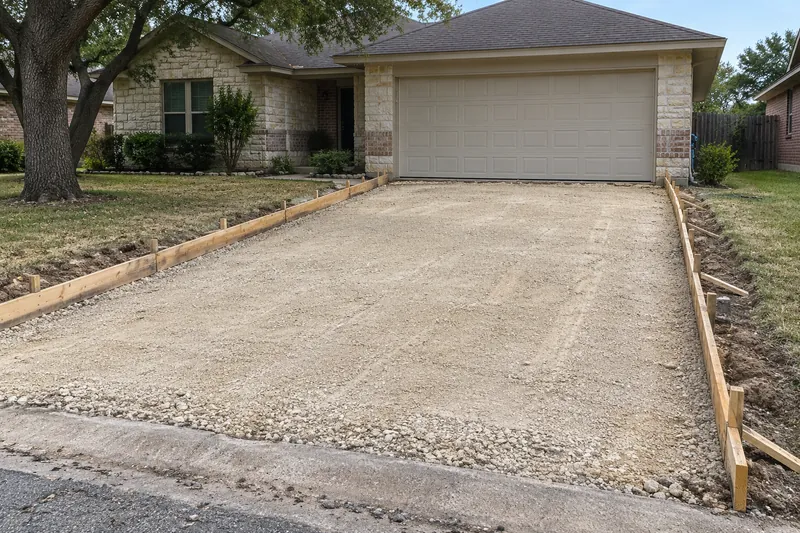
Thickness only works on a sound base. One published guide puts at least 4 inches of subbase and base under a slab, and ACI 302 wants that base compactable and granular, 10 to 30% fines, with clay, silt and organic material kept out. The Michigan guideline digs out unstable subgrade at least 6 inches down and backfills with crushed stone, gravel or sand compacted to 95%. On expansive soils such as Houston Black clay, which the USDA rates "Very limited" for concrete driveways and sidewalks in McLennan County, 2 to 8 inches of crushed rock is the recommended subgrade, depending on how expansive the soil is; the black clay and weather guide explains why.
At the street and in the garage
Many municipalities call for a 5- or 6-inch apron at the street to carry more load, and in Waco the ST-23B detail makes the approach 6 inches thick, in reinforced 3,000 psi concrete; our driveway aprons page covers that strip, and the approach and sidewalk permit guide the City's rules for it. Inside the garage, the International Residential Code's minimum for a concrete floor on ground is 3½ inches, and it puts garage floor slabs in its strongest concrete category. Garage and shop floors are on our concrete slabs page.
Call or request a free estimate any time, 24/7.
(254) 309-9254Concrete strength and the mix (psi)
The National Ready Mixed Concrete Association's freeze-thaw guidance for exterior slabs is 4,000 psi concrete, in line with ACI 332, the residential concrete code, dropping to 3,500 psi when the slab won't stay wet all the time or won't get deicing chemicals, with 6 percent air and a 3 to 5 inch slump. TxDOT's Class A, the general-use class it lists for curbs, gutters, sidewalks and driveways, carries a 3,000 psi minimum design strength and a water-cementitious ratio of 0.60 at most, and TxDOT doesn't air-entrain concrete unless the plans call for it. For garage floors, carport slabs, porches and steps exposed to the weather, the IRC's 28-day minimums are 2,500, 3,000 or 3,500 psi, by weathering area.
Water is the other half of the mix. Driveway concrete should have a slump of about 4 inches; the Portland Cement Association's warning is to avoid any slump above 5 inches, and one published guide keeps the water-cement ratio below 0.50. Stronger concrete costs more per load: typical national delivery prices in 2025 ran $160 to $170 a cubic yard for 3,000 psi and $180 to $190 for 4,000 psi.
Call or request a free estimate any time, 24/7.
(254) 309-9254Rebar, wire mesh and fiber in a driveway
What the steel does
Concrete's tensile strength is only about 15% of its compressive strength, and that shortfall is why many slabs need reinforcement. Steel supplies the missing tensile strength, but only at or just above mid-depth, and the IRC requires slab reinforcement to stay between the slab's center and its upper third for the whole pour. The National Ready Mixed Concrete Association wants at least 2 inches of concrete over the steel to keep salt and moisture away from it, and says reinforcement limits how wide cracks open rather than preventing them.
Rebar vs. wire mesh
Mesh is the usual pick for a drive 4 to 5 inches thick; from 5 inches up, ½-inch (#4) rebar takes over, set in a grid about 12 inches apart on blocks. Mesh tends to keep cracks and joints from opening up, and should be cut or stopped across contraction joints. One rule of thumb puts rebar or welded wire fabric in any slab over 5 inches deep, though many slabs on a good base with properly spaced joints don't need reinforcement. Synthetic fibers, usually 1 to 2 pounds per cubic yard, are added to reduce plastic shrinkage and settlement cracks.
What reinforcement adds to the price
The gap shows in typical Waco 2024 driveway prices, where a reinforced drive runs $7 to $11 per square foot against $6 to $10 for a plain one. Nationally, steel rebar adds $1 to $3 per square foot (2025). These are published averages, not a quote; the rest of the price lines are in the Waco concrete cost guide.
Control joints
Joint grooves go at least a quarter of the slab's depth, never less than 1 inch, and are sawn 1 to 4 hours after finishing with early-entry saws or 4 to 12 hours after with conventional ones. Panels between joints should be square or close to it, with the long side no more than 1.5 times the short side.
- Joint groove ¼ of the slab depth, never under 1 in. (NRMCA)
- Broom texture for a non-slip surface (NRMCA)
- 4 in. minimum; 5 in. where delivery trucks use the drive
- Mesh, or #4 rebar in drives 5 in. or thicker, 2 in. of cover
- At least 4 in. of compacted base; 2 to 8 in. of crushed rock on expansive soil
- Unstable soil removed at least 6 in. deep and replaced
Call or request a free estimate any time, 24/7.
(254) 309-9254Curing time: when to walk, drive and seal
The first week of curing
The National Ready Mixed Concrete Association says to begin curing as soon as the concrete is placed and finished and to keep it up, typically, for 3 to 7 days, under a curing compound meeting ASTM C309 or C1315, applied once the surface water sheen disappears and best in two coats at right angles, or under plastic sheeting at least 4 mils thick. It adds that concrete kept dry can end up as much as 50 percent short of its potential strength, compared with moist-cured concrete.
Walking and driving on new concrete
Common timelines allow foot traffic after 48 hours, bicycles, scooters and skateboards after three days, and a car after 7 to 10 days, as long as it stays off the edges. The Illinois Ready Mixed Concrete Association's homeowner guide keeps cars off new concrete for at least 7 days. Hold RVs and big trucks off for 28 days or more, and after 30 days the drive takes all normal traffic except heavy commercial vehicles such as garbage trucks.
Curing in Waco heat and cold
One published guide puts the best curing range at 50°F to 80°F air temperature, and Waco is often outside it: NOAA's 1991–2020 normals give the city 114.8 days a year of 90°F or hotter and 34.1 days at or below freezing. In hot weather, NRMCA says curing should continue for at least 3 days. In cold weather, the American Concrete Institute's guide applies once the air temperature during the protection period has fallen to 40°F or is expected to drop below it, and NRMCA says fresh concrete has to be protected from freezing until it reaches 500 psi, roughly two days after it is placed.
Sealing a new driveway
The Michigan Concrete Association's guidance is that "A penetrating sealer can be applied 30 days after initial placement and typically needs to be reapplied every three to five years." Penetrating sealers, made of silicones, siloxanes and silanes, add no gloss or slipperiness. Deicers are best kept off a new drive in its first winter. Sealers for older drives are on our resurfacing and sealing page.
Call or request a free estimate any time, 24/7.
(254) 309-9254Driveway thickness, rebar and curing questions
Can concrete be 2 inches thick?
Not for a driveway. One published guide starts driveways at 4 inches, the USDA's soil ratings describe driveways and sidewalks as poured concrete slabs 3 to 6 inches thick, and the International Residential Code's minimum for a concrete floor on ground is 3½ inches.
What is the recommended rebar spacing for a 4-inch slab?
One published guide pairs a 4-inch drive with wire mesh rather than rebar; #4 rebar in a grid about 12 inches apart is the usual spec once a drive is 5 inches or thicker. For comparison, Waco's 6-inch drive approach detail uses #4 bars at 18 inches on center both ways, set on concrete chairs.
What is the minimum concrete cover required?
The National Ready Mixed Concrete Association calls for at least 2 inches of concrete cover over reinforcing steel, which keeps salt and moisture away from it and helps prevent rust-related cracking.
What happens if concrete dries too fast?
It loses strength and cracks. In extreme cases, skipping curing right after final finishing can leave concrete up to 50% weaker. If the surface dries before the concrete sets, plastic shrinkage cracks form, usually running parallel 1 to 3 feet apart; they are shallow and unsightly but rarely weaken pavements.
How long after pouring a concrete slab can you remove the forms?
For concrete on public property, Waco's code sets the outside limit: the contractor must remove all forms and bracing within six days after the minimum time set for removing them, or seven days after the concrete is placed and finished.
Can I drive on concrete after 5 days?
Usually not yet. About seven days after placement a driveway has reached only roughly 70% of its potential strength, and the Michigan Concrete Association allows traffic after 7 days of curing, or earlier only once testing confirms 2,500 psi.
What is the maximum curing period for concrete?
Active curing, keeping the concrete moist or under a curing compound, normally lasts 3 to 7 days. Concrete keeps gaining strength well past that: the whole curing period is about 28 days, the age at which the IRC's strength minimums are measured.
Get a free estimate on a new driveway in Waco
Calls and estimate requests are answered 24/7. Choose the driveway job in the form or call, and the free estimate covers the thickness, steel and base for what will park on it.