Concrete Questions and Answers for Waco, TX Property Owners
Waco Elite Concrete answers the concrete questions Waco property owners ask most, from what concrete costs and which City permits apply to black clay, cracking and sealing.
The answers draw on the City of Waco's rules, the USDA soil survey, the National Weather Service and industry groups such as the National Ready Mixed Concrete Association. Prices are typical Waco, Central Texas or national figures with their year, not quotes. Twelve common questions also have a page of their own, listed at the bottom. For a price on your own job, call or send a request any time: estimates are free, and requests are answered 24/7.
Call or request a free estimate any time, 24/7
Concrete contractor and estimate questions
Does a concrete contractor need a license in Texas?
Not one that the Texas Department of Licensing and Regulation issues. The agency lists 41 regulated programs, from electricians to water well drillers, and none of them covers general contractors, home builders or concrete work. The state body that used to register home builders, the Texas Residential Construction Commission, was abolished on September 1, 2009. In Waco, the City's registration list for trade contractors names plumbing, electrical, mechanical and HVAC, irrigation, propane and sign contractors, not concrete. What the City does require is a $5,000 Concrete Contractor's Bond from anyone who wants a permit for sidewalks, gutters, curbs, driveways and other concrete work on public property.
What to ask a concrete contractor?
Ask about the parts you won't see once the concrete is down. How thick will it be for what drives or sits on it? One published guide puts a home driveway for cars and SUVs at 4 inches and one for heavy trucks or RVs at 5 or 6. Where will the steel sit? It has to be at or just above the middle of the slab to do its job. How far apart are the joints? NRMCA's maximum spacing is 24 to 36 times the slab thickness, which works out to about 10 feet for a 4-inch slab. What goes underneath? The base and subbase should add up to 4 inches or more. If the work reaches the street, ask whether the contractor is bonded with the City, because Waco issues right-of-way concrete permits only to bonded contractors. And ask about the deposit: on stamped work, contractors typically ask for 10% to 33% of the total, in national 2026 figures.
What are concrete services?
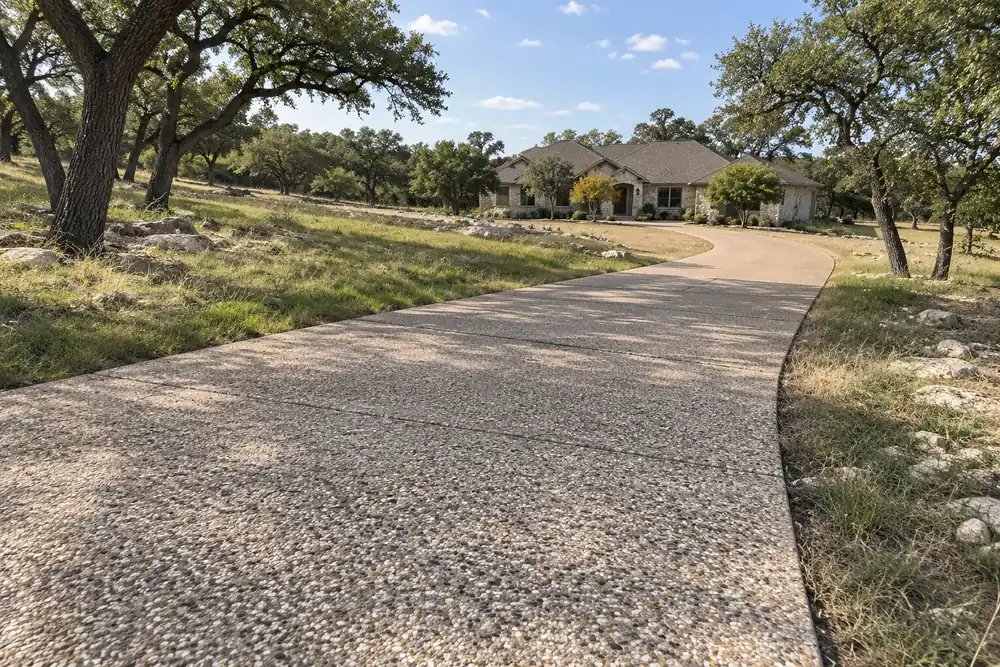
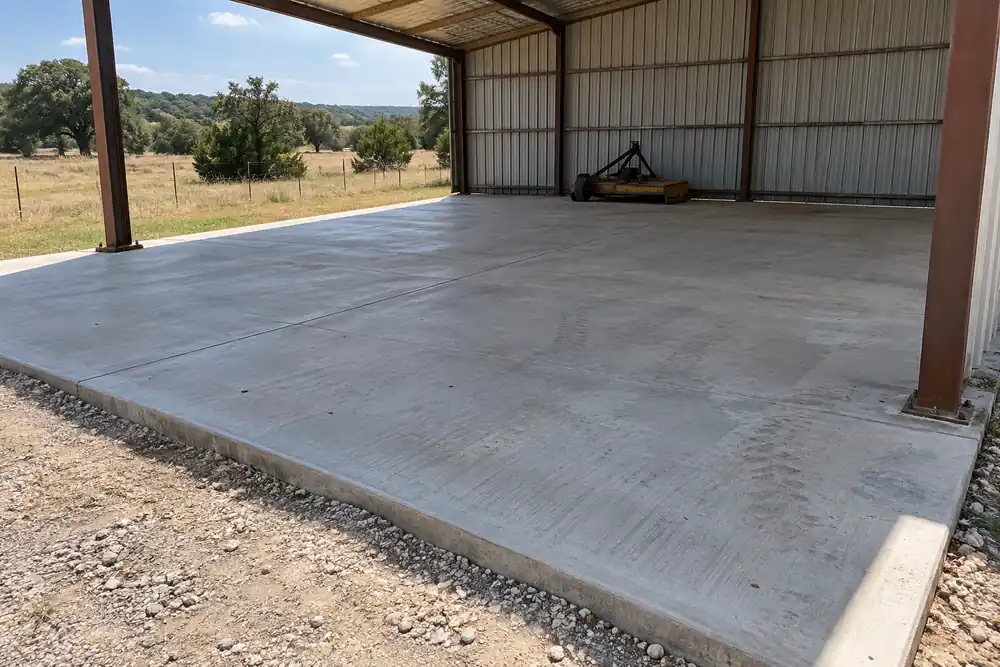
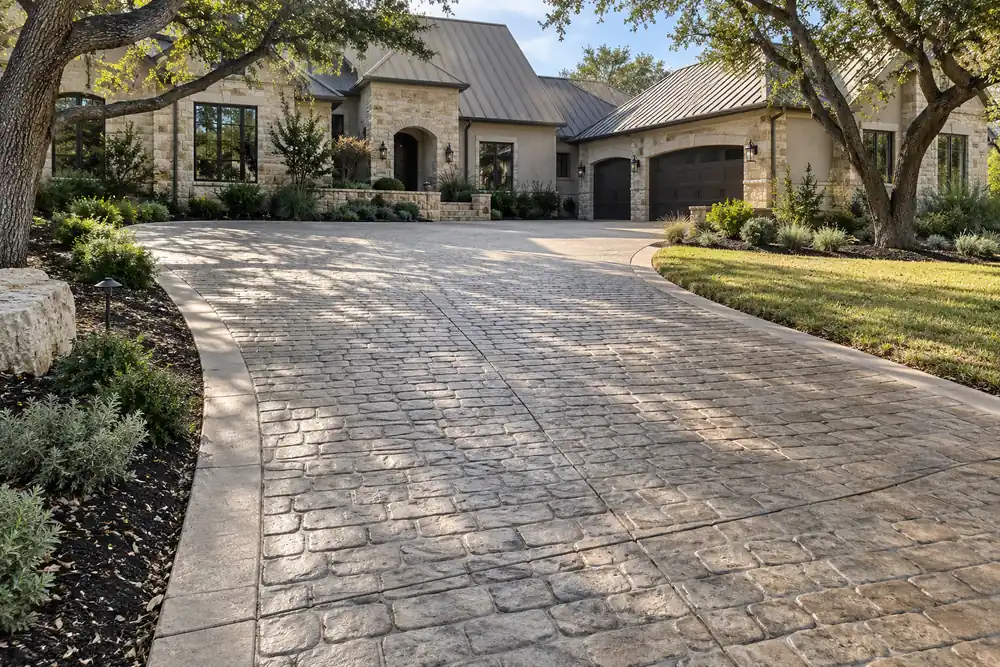
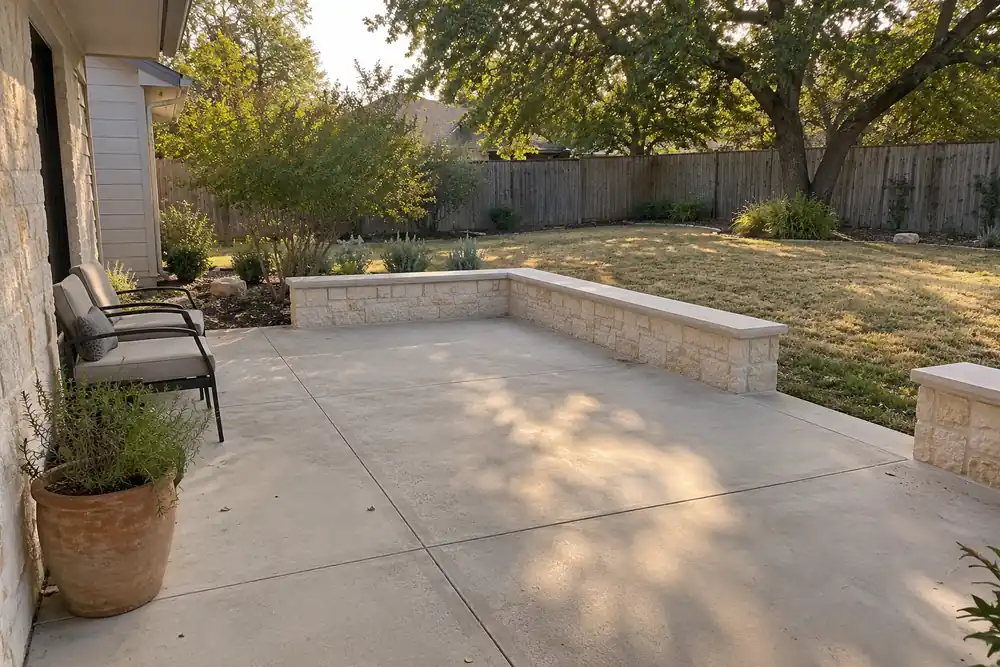
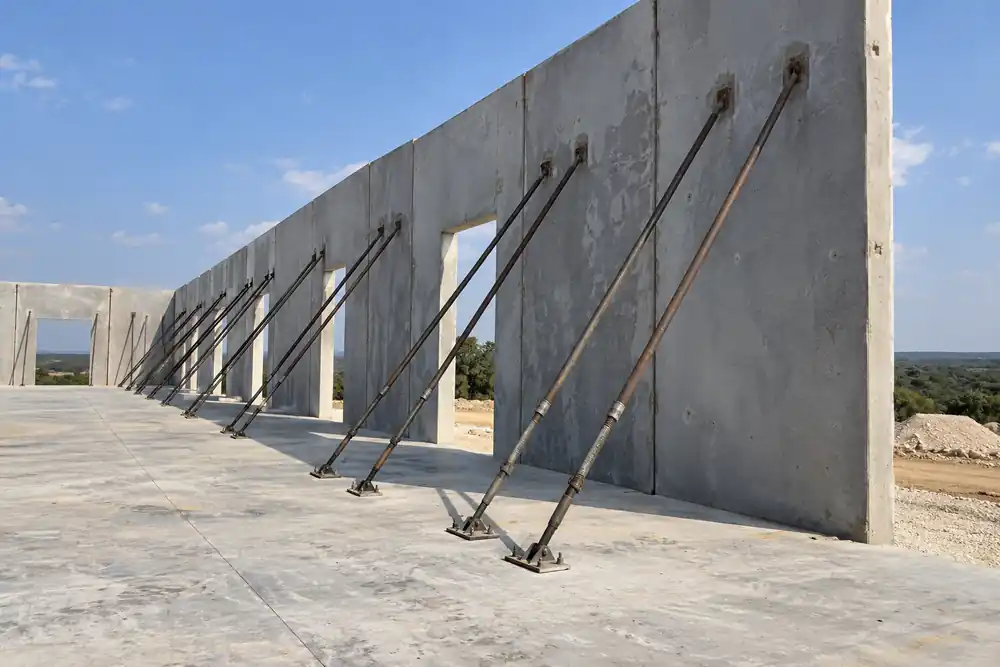
Pouring new concrete, finishing it and keeping old concrete in service. Waco Elite Concrete pours concrete driveways, slabs and slab foundations, patios, sidewalks, steps and pads, in plain, stamped, stained or exposed aggregate finishes, and commercial concrete from parking lots and drive approaches to industrial floors and tilt-wall. For older concrete, the work is crack and spall repair, leveling, resurfacing, sealing and removal. Every job has its own page in the list of Waco concrete services.
Do you charge for an estimate?
No. Waco Elite Concrete gives free estimates, and calls and estimate requests get an answer around the clock, on weekends too. A real price needs a look at the job: its size and slope, how close the concrete truck can get, any old concrete that has to come out and the clay underneath. The estimate itself costs nothing.
Which towns around Waco do you work in?
Waco Elite Concrete takes concrete jobs across Waco, Beverly Hills, Woodway, Willow Grove, Bellmead, Lacy-Lakeview, Hewitt, Robinson, China Spring, Gholson, Lorena, Ross, Hallsburg, Golinda, Crawford, Riesel, Leroy, McGregor, Bruceville-Eddy, West, Valley Mills, Moody, Chilton, Aquilla, Mart, Oglesby, Mount Calm, Abbott, Laguna Park, Marlin and Mosheim. Each town has its own page in our service areas near Waco. McLennan County alone covers 1,031 square miles, according to the Texas State Historical Association, so if your town isn't on the list, call and ask.
Have a question about your own job? Call or request a free estimate, 24/7.
(254) 309-9254Concrete mix, base and joint questions
What types of concrete are there?
Ready-mix is sold by type and by strength. Typical Central Texas prices for 2026 run from all-purpose concrete at $120 to $165 a cubic yard through shotcrete, high-strength, modern and self-consolidating mixes to limecrete at $195 to $205. By strength, typical Waco 2025 prices are listed for 3,000, 4,000 and 5,000 psi concrete. TxDOT sorts its concrete into classes: Class A, the general class it uses for curb, gutter, sidewalks and driveways, is designed for at least 3,000 psi, and Class P is its pavement concrete.
Do I need a vapor barrier under a concrete slab?
Under a house, yes. Waco's residential permit rules put a 6-inch sand base under a house slab, topped by a 6 mil polyethylene vapor barrier, and NRMCA's recommendation for interior slabs is a vapor retarder 10 mils thick or more. Outdoors it's different: NRMCA says vapor retarders generally aren't needed under exterior slabs on grade, and the 2015 International Residential Code doesn't require one for garages, utility buildings and other unheated accessory structures.
What goes under a concrete driveway or patio?
A compacted base on firm ground, at least 4 inches of base and subbase together. ACI 302's recommendation is a granular material that compacts, with 10 to 30% fines and free of clay, silt and organic matter. Where the soil is expansive, like the clayey upland soils that cover about 26 percent of McLennan County, one published guide calls for 2 to 8 inches of crushed rock as subgrade, depending on how expansive it is, with soft spots dug out and replaced. At the curb, the City's residential approach detail puts 4 inches of base material under the concrete.
What is the difference between control joints and expansion joints?
Control joints, also called contraction joints, are cut or tooled grooves that give the slab a place to crack. NRMCA's minimum groove depth is a quarter of the slab thickness, and never under 1 inch, with the panels between them close to square and never longer than 1.5 times their width. Isolation or expansion joints run the full depth instead and separate a driveway or patio from sidewalks, garage slabs, stairs, light poles and other fixed points, so each part can move on its own. Wire mesh doesn't prevent cracking, NRMCA adds; what it does is help hold cracks and joints closed.
Planning a slab, drive or patio? Call or request a free estimate, 24/7.
(254) 309-9254Concrete cost questions
How much does concrete cost?
Concrete is priced by the job. In typical Waco figures, a reinforced 10 × 10 patio runs $700 to $1,100 (2022), a reinforced 12 × 40 driveway $3,100 to $5,400 (2024) and a reinforced 20 × 30 slab $5,500 to $9,400 (2024). Our guide to concrete cost in Waco sets driveways, slabs, patios, ready-mix and the other services side by side, and Waco Elite Concrete prices your own job at a free estimate.
How much does it cost to tear out old concrete in Waco?
A typical Waco figure for demolishing old concrete is $1.20 to $1.90 per square foot (2024). Reinforced concrete costs more to take out: nationally, removal runs $4 to $6 per square foot for reinforced concrete against $2 to $4 for unreinforced (2025), and dump fees run $30 to $65 per pickup load or $90 to $160 per ton. Our concrete removal page covers breaking out and hauling away old slabs.
How much does a bag of concrete cost?
National 2026 prices run $4.49 for a 50-pound bag of light-weight concrete, $4.57 for 50 pounds of fast-setting mix, $5.57 for a 60-pound bag of mortar mix and $11.50 for a 94-pound bag of Portland cement. A 50-pound bag yields 0.014 cubic yards. Ready-mix, by comparison, runs $128 to $154 a cubic yard in typical Waco 2025 figures.
Is a concrete slab cheaper than a foundation?
A slab is one kind of foundation, and nationally it's the least expensive kind. National 2026 figures put slab-on-grade foundations at $4 to $12 per square foot, monolithic slabs at $4 to $16, stem wall foundations at $6 to $18 and pier-and-beam at $6 to $15, with an average foundation pour of $12,000 and most jobs between $6,000 and $42,000. On the deeper clays in the Waco area, the county soil survey calls for foundations engineered to the soil's properties.
Want a price for your own job? Call or request a free estimate, 24/7.
(254) 309-9254Waco concrete permit questions
Which concrete jobs need a permit in Waco?
Inside the city, a driveway, patio or other flatwork on private property doesn't, but anything in the right-of-way does: a drive approach, public sidewalk or curb needs its own Engineering Department permit, apart from any building permit. Inspection Services adds a few cases that involve concrete. A retaining wall over 48 inches must be engineered and needs a Foundation permit, anything over 200 square feet built as an accessory structure takes a Residential Accessory Structure permit, and decks and covered porches count as Residential Additions. Our guide to Waco driveway, approach and sidewalk permits walks through the right-of-way rules.
Do the cities around Waco require permits for driveways and patios?
Some do and some don't, so go by the city your address is in. Lacy-Lakeview names driveways and sidewalks on its list of projects needing a permit. Robinson's permit page names pools deeper than 24 inches, decks over 200 square feet or 30 inches high, and fences and retaining walls, with engineered plans for walls over four feet, but not driveways, sidewalks or flatwork, though a stand-alone drive approach permit and inspection there costs $75.00. Woodway's fee schedule, effective October 1, 2026, charges $100.00 per drive approach, and Bellmead's right-of-way permit for a driveway, sidewalk, curb or street construction is $50. Waco Elite Concrete checks which city's rules apply at the free estimate.
Does a new home in Waco need a sidewalk?
In infill areas, it can. The City's code requires a sidewalk when an infill lot next to an existing sidewalk is developed, and it makes the developer, owner or builder repair or replace an existing infill sidewalk that's in disrepair, which the code describes as "excessive cracking or significant vertical displacement at joints or cracks". New walks must be at least 6 feet wide along arterial streets and 5 feet along collector streets, each with a 4-foot planting strip. Our page on concrete sidewalks and walkways covers the rest of the City's sidewalk details.
Work at the street or the curb? Call or request a free estimate, 24/7.
(254) 309-9254Black clay, weather and concrete cracking
Why does concrete crack in Waco?
Two things work together. The ground moves: Houston Black clay, mapped across 41,197 acres of McLennan County, has a very high shrink-swell potential, and the county soil survey says that movement can crack or buckle houses, roads, streets and sidewalks. And the concrete itself moves, contracting and expanding with moisture and temperature. NRMCA says completely crack-free concrete isn't possible, and that most cracks trace back to design and construction mistakes such as missing joints, poor subgrade preparation, too much water, poor finishing, fast drying and little or no curing. Concrete that cracks within a few years of being poured may point to an installation error. The guide to concrete on Waco's black clay goes into the soil in depth.
When is the best time of year to pour concrete in Waco?
One published guide says concrete cures best between 50°F and 80°F, and Waco's calendar shows when that takes planning. In summer, the National Weather Service puts Waco's average first 100°F day on July 4 and its average last on August 30, and ACI's hot-weather limit for concrete leaving the truck is 95°F. In winter, cold-weather practice under ACI's guide starts at an air temperature below 40°F, actual or forecast, during the protection period, and the Weather Service's average freeze dates for Waco are November 21 (first) and March 11 (last). May and October are the wettest months, with 4.44 and 4.41 inches of normal rainfall (1991–2020). Curing in the heat and cold is covered in the driveway curing guide.
Planning around the weather? Call or request a free estimate, 24/7.
(254) 309-9254Concrete repair, sealing and upkeep questions
Should I repair, level or replace cracked concrete?
It depends on what the damage is doing. A spall that stays in the top third to half of the slab without exposing steel can take a partial-depth patch, but no partial-depth repair fixes a crack running through the full slab. A slab that has sunk can be raised by slabjacking, though if a cause such as roots or a leaking pipe washing out the ground underneath is found, replacing the slab may be the only fix. Deep or wide cracks with one side higher than the other can signal settlement and unstable ground rather than a surface problem, and once a driveway passes about 30 years, full replacement is usually the better choice. Waco Elite Concrete looks at the slab and the ground under it before recommending concrete repair, leveling or a new pour.
Is sealing concrete worth it in Texas?
For outdoor flatwork, one published guide says yes: a high-quality sealer every few years helps keep moisture out. The American Society of Concrete Contractors treats decorative sealer as a sacrificial coat, and its rule of thumb is a fresh coat every 2 to 3 years where traffic and sun are heavy and every 4 to 5 years on lighter-use and indoor areas. Heat matters here: ASCC's window for water-based sealers is 45°F and rising, up to 90°F, for both the air and the concrete, and Waco's normal July high is 96.7°F. National 2025 figures put cleaning and sealing at $1 to $3 per square foot. Our page on concrete resurfacing and sealing covers sealer types and overlays.
When should new stamped concrete be sealed?
Not right away. Most manufacturers recommend applying the final sealer several weeks after stamping, after a light surface cleaning, and the American Society of Concrete Contractors' sealer guide counts leftover release on the surface as "one of the biggest reported sealer problems". After that, plan on resealing every two to three years; typical Central Texas figures (2026) put each round at roughly $1.20 to $2.50 per square foot. Our stamped concrete page covers patterns, colors and upkeep.
How long does concrete last?
With care, decades. One published guide puts a concrete patio at 30+ years and a sidewalk at 20 to 40 years, and says an interior concrete floor can last indefinitely when it's properly installed and sealed. The ground is the variable in Waco: for soils the USDA survey rates "Very limited", such as Houston Black clay, it expects poor performance and high maintenance unless special design or installation overcomes the limits.
More concrete questions, answered one by one
These twelve questions each have a page of their own, with a short, direct answer.
- How much is a yard of concrete in Texas right now?
- How much does a 20x20 concrete slab cost to pour?
- What psi should a concrete slab be?
- What is post tension concrete?
- What is the standard thickness of a concrete driveway?
- What is stamped concrete?
- Can you add on to existing concrete?
- How much does 100 feet of sidewalk cost?
- Is mudjacking a permanent fix?
- Is there any way to repair cracked concrete?
- What is the cheapest way to resurface a concrete driveway?
- How much does it cost to do a concrete retaining wall?
Ask about your own concrete job
Calls and requests get an answer 24/7. Say which job it is on the form, with a way to reach you, and the estimate is free.